IT Outsourcing Models: Types, Benefits & How to Choose
Businesses rarely have identical IT requirements. A startup may need a small development team for a new application, while an established company may need continuous help desk support, cybersecurity monitoring, cloud management, or infrastructure administration. This is why understanding IT outsourcing models is important before choosing an external technology provider.
The right outsourcing model determines how services are delivered, who manages the work, how flexible the engagement is, and how the provider and client share responsibilities. Common models include managed services, project-based outsourcing, staff augmentation, dedicated teams, build-operate-transfer arrangements, and hybrid or co-sourcing.
Choosing the right model depends on factors such as the type of IT work, required expertise, project duration, budget, desired control, security requirements, and internal capabilities.
What Are IT Outsourcing Models?
IT outsourcing models are different structures businesses use to work with external IT service providers.
The model defines important aspects of the relationship, including:
- What work the provider performs
- How the external team is organized
- Who manages employees and processes
- How the provider is paid
- How long the engagement lasts
- How responsibilities are divided
- How performance is measured
- How much control the client retains
For example, a company that wants continuous IT support might choose a managed services model. A business that needs ten additional developers for six months might prefer staff augmentation.
Therefore, selecting an outsourcing model should start with the business requirement rather than the provider’s preferred service structure.
Why Businesses Use Different IT Outsourcing Models
There is no single outsourcing arrangement that works for every technology requirement.
Businesses outsource for different reasons. Some need specialized expertise, while others need additional capacity or ongoing operational support. A company may also use different models simultaneously.
For example, an organization could:
- Use managed IT services for infrastructure
- Use a cybersecurity provider for security monitoring
- Add external developers through staff augmentation
- Hire a dedicated team for a long-term application
- Outsource a specific software project on a fixed basis
This flexibility allows companies to build an outsourcing strategy around their actual needs.
6 Common IT Outsourcing Models
1. Managed Services Model
The managed services model involves an external provider taking ongoing responsibility for defined IT services.
A managed service provider, or MSP, may handle areas such as:
- Help desk support
- Network management
- Cloud infrastructure
- Endpoint management
- Backup and recovery
- Cybersecurity
- System monitoring
- Device management
The provider generally operates under an ongoing service agreement with defined responsibilities and service levels.
This model is particularly useful for businesses that want continuous IT support without building a large internal team for every function.
Best for: Ongoing IT operations and support.
Example: A growing business hires an MSP to manage its network, employee devices, cloud environment, backups, and technical support.
2. Project-Based Outsourcing
Project-based outsourcing is designed around a specific technology project with defined deliverables.
Examples include:
- Website development
- Software development
- Cloud migration
- ERP implementation
- Data migration
- Application modernization
- Infrastructure upgrades
The provider is responsible for delivering agreed work within an established scope, timeline, or set of milestones.
This model can be effective when the business has a clear project but does not need a permanent external team afterward.
Best for: Defined projects with specific deliverables.
Example: A company hires an IT provider to migrate its legacy applications to a cloud environment.
One challenge is managing scope. If requirements change substantially during the project, costs and timelines may also change depending on the contract structure.
3. Staff Augmentation Model
Staff augmentation allows a business to add external IT professionals to its existing team.
Instead of outsourcing an entire project, the organization adds people with specific skills.
For example, a company might bring in:
- Software developers
- Cloud engineers
- QA specialists
- Data engineers
- Cybersecurity professionals
- DevOps engineers
- UI/UX designers
The internal organization typically retains greater day-to-day control over the work than it would with a fully outsourced project.
Best for: Temporary skill gaps, increased workloads, or projects requiring additional technical capacity.
Example: An internal software team needs three additional developers for eight months to accelerate a product release.
The main advantage is flexibility. However, the business must still provide effective management, communication, task allocation, and technical leadership.
4. Dedicated Team Model
A dedicated team is an external group of professionals assigned to work primarily or exclusively on a client’s long-term requirements.
The team may include several complementary roles, such as:
- Developers
- Project managers
- QA engineers
- Designers
- DevOps specialists
- Business analysts
Unlike staff augmentation, where individual professionals are added to an existing organization, a dedicated team can operate as a more cohesive external unit.
Best for: Long-term product development and ongoing technology initiatives.
Example: A software company establishes a dedicated external development team to build and maintain a new SaaS product.
This model can provide greater continuity than short-term staffing, but businesses should establish clear ownership, communication processes, security controls, and performance expectations.
5. Build-Operate-Transfer Model
The build-operate-transfer (BOT) model involves an external provider helping establish and operate a team or capability before eventually transferring it to the client.
The general structure is:
- Build: The provider recruits and establishes the team.
- Operate: The provider manages or supports the operation for an agreed period.
- Transfer: Responsibility and operations transition to the client.
This model can be useful for businesses that want to establish a new technology operation but do not initially have the local recruitment, management, or infrastructure capabilities to do so efficiently.
Best for: Businesses planning to develop a long-term internal capability.
The transition phase needs careful planning. Businesses should determine in advance how knowledge, personnel, processes, technology, contracts, and responsibilities will be transferred.
6. Co-Sourcing or Hybrid Model
Co-sourcing combines internal employees with external IT professionals or providers.
Instead of outsourcing an entire IT function, a business assigns specific responsibilities to an external provider while keeping other responsibilities internally.
For example:
- Internal IT manages business applications
- An MSP manages infrastructure
- An external security provider handles security monitoring
- Internal leadership manages IT strategy
- An external development team supports product engineering
This model can provide flexibility and allow organizations to retain internal knowledge while gaining access to external expertise.
Best for: Businesses that want a balance between internal control and external capabilities.
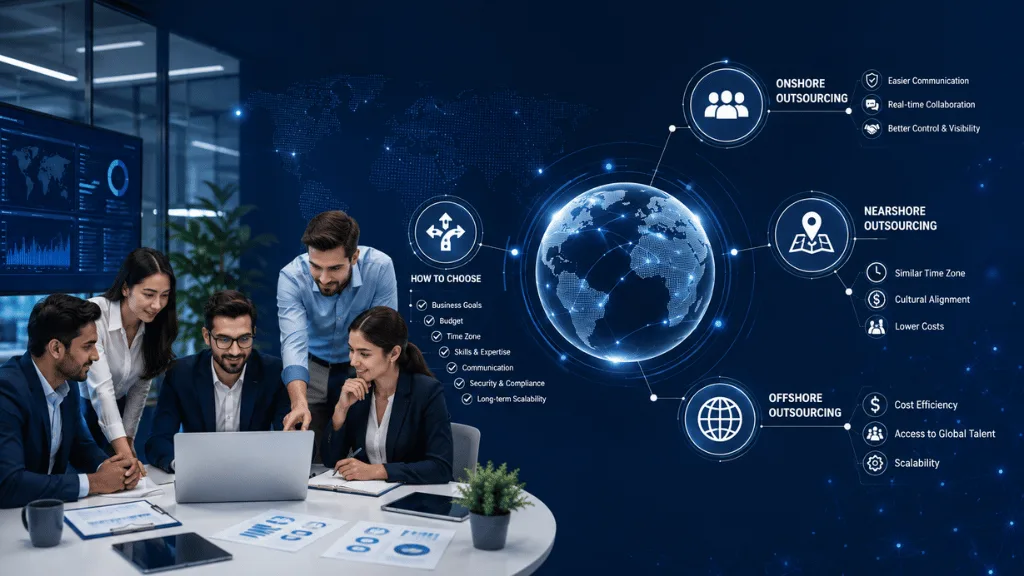
Onshore vs Nearshore vs Offshore Outsourcing
IT outsourcing models can also be classified by where the external team is located.
Onshore Outsourcing
Onshore outsourcing means working with a provider in the same country as the client.
Potential advantages include:
- Similar business environment
- Easier communication
- Fewer time-zone challenges
- Potentially simpler legal and regulatory coordination
The primary trade-off may be higher labor costs compared with some international alternatives.
Nearshore Outsourcing
Nearshore outsourcing involves working with a provider in a nearby country or region.
The goal is often to balance cost, access to talent, time-zone compatibility, and cultural or geographic proximity.
Nearshore arrangements can be attractive when businesses want international talent while limiting large time-zone differences.
Offshore Outsourcing
Offshore outsourcing involves working with a provider in a more distant country or region.
Potential advantages can include access to larger talent pools and different cost structures.
However, businesses should carefully evaluate:
- Time-zone differences
- Communication
- Data protection
- Contract enforcement
- Security
- Cultural differences
- Quality management
- Business continuity
Location is therefore only one part of choosing an outsourcing arrangement.
Benefits of IT Outsourcing Models
The right outsourcing model can provide several potential business benefits.
Access to specialized expertise
External providers can give organizations access to professionals with specialized technical skills without requiring the company to hire every specialist internally.
Greater flexibility
Staff augmentation, dedicated teams, and other flexible arrangements can help organizations respond to changing workloads.
Potential cost efficiency
Outsourcing can change how businesses allocate technology costs and staffing resources. However, savings depend on the engagement model, scope, provider, and internal alternative.
Faster access to capabilities
An established provider may already have technical expertise, processes, and recruitment capabilities that a business would otherwise need to develop.
Ability to focus on core activities
Outsourcing routine or specialized technology functions can allow internal teams to focus on business priorities.
Scalability
External resources can sometimes be adjusted more easily than permanent internal staffing.
Access to broader technology capabilities
Specialist providers may offer expertise across cloud, cybersecurity, software engineering, infrastructure, data, and other technology areas.
IT Outsourcing Model Comparison
IT Outsourcing Model | Best For | Control Level | Typical Engagement | Key Advantage |
Managed services | Ongoing IT operations | Medium | Long-term | Continuous support |
Project-based | Defined projects | Medium | Short to medium-term | Clear deliverables |
Staff augmentation | Skill or capacity gaps | High | Short to medium-term | Flexible staffing |
Dedicated team | Long-term development | Medium-high | Long-term | Team continuity |
Build-operate-transfer | Building internal capability | High over time | Long-term | Planned transition |
Co-sourcing | Mixed internal/external IT | High | Flexible | Balanced approach |
There is no universally superior model. The appropriate choice depends on the organization’s objectives and operating environment.
How to Choose the Right IT Outsourcing Model
1. Define the business objective
Start by identifying what you actually need to accomplish.
Are you trying to:
- Maintain IT infrastructure?
- Develop software?
- Fill a temporary skills gap?
- Improve cybersecurity?
- Reduce operational workload?
- Build a new technology team?
- Complete a one-time migration?
The answer will narrow the list of suitable models.
2. Determine whether the need is temporary or ongoing
A temporary project may be better suited to project-based outsourcing or staff augmentation.
An ongoing operational requirement may be more appropriate for managed services.
A long-term product initiative could benefit from a dedicated team.
3. Assess your internal IT capabilities
Identify the skills and responsibilities you already have internally.
Ask:
- What can our team manage effectively?
- Where are the skill gaps?
- Which functions are business-critical?
- Which tasks consume too much internal capacity?
- Which responsibilities require specialist expertise?
This helps determine what should actually be outsourced.
4. Consider your desired level of control
If internal managers need direct control over external professionals, staff augmentation may be appropriate.
If the organization wants a provider to manage an entire function, managed services may be more suitable.
The more responsibility transferred to the provider, the more important contractual clarity and governance become.
5. Evaluate security requirements
Technology outsourcing can involve access to business systems and sensitive information.
Businesses should evaluate:
- Access controls
- Data protection
- Authentication
- Monitoring
- Incident response
- Backup procedures
- Vendor risk
- Compliance requirements
NIST recommends evaluating third-party providers’ qualifications, capabilities, experience, and security practices when organizations rely on external IT security services. (nist.gov)
6. Compare total costs
Do not compare outsourcing prices only with employee salaries.
Consider the full cost of an internal alternative, including:
- Recruitment
- Salaries and benefits
- Training
- Management
- Software
- Infrastructure
- Security tools
- Equipment
- Employee turnover
- Specialized consultants
Then compare those costs with the full expected cost of the outsourcing arrangement.
7. Establish measurable expectations
Define what success looks like before signing an agreement.
Depending on the model, useful measures may include:
- Response times
- Resolution times
- System availability
- Project milestones
- Defect rates
- Development velocity
- Security response
- Customer satisfaction
Service-level agreements and performance metrics can help turn general expectations into measurable commitments.
8. Plan for the end of the relationship
Even a successful outsourcing relationship may eventually change.
Businesses should understand:
- Who owns data and intellectual property
- How systems will be documented
- How access will be removed
- How knowledge will be transferred
- What happens to equipment
- How services will transition to another provider or internal team
Planning the exit at the beginning can reduce future disruption.
Common IT Outsourcing Mistakes to Avoid
Choosing based only on price
The cheapest provider may not offer the expertise, security, service quality, or reliability required by the business.
Outsourcing without clear responsibilities
Ambiguous responsibilities can create gaps. Contracts should clearly identify what the provider manages and what remains the client’s responsibility.
Ignoring security
Third-party access can introduce supply-chain and vendor risks. Security requirements should be evaluated before access is granted.
Failing to document business requirements
A provider cannot reliably deliver an undefined outcome. Businesses should establish requirements, priorities, scope, and success measures.
Not planning communication
Different locations, time zones, teams, and working practices can create communication problems. Establishing clear communication channels and meeting routines is important.
Becoming overly dependent on one provider
Strong documentation and an appropriate exit plan can reduce operational dependency.
FAQs About IT Outsourcing Models
What are the main IT outsourcing models?
The main models include managed services, project-based outsourcing, staff augmentation, dedicated teams, build-operate-transfer, and co-sourcing or hybrid outsourcing. Businesses may also combine several models.
Which IT outsourcing model is best for a small business?
A small business with ongoing technology support needs may consider managed IT services. However, the best model depends on its internal capabilities, technology environment, security requirements, budget, and business goals.
What is the difference between staff augmentation and a dedicated team?
Staff augmentation typically adds individual external professionals to an existing team, while a dedicated team is generally structured as a more cohesive external unit for longer-term work. The exact management arrangement depends on the provider and contract.
What is the difference between managed services and project-based outsourcing?
Managed services usually involve ongoing responsibility for defined IT functions, whereas project-based outsourcing focuses on delivering a specific project or set of outcomes.
Is offshore outsourcing an IT outsourcing model?
Offshore outsourcing describes the location of the provider rather than the service structure itself. For example, a business could use offshore managed services or an offshore dedicated development team.
Can businesses combine multiple IT outsourcing models?
Yes. A hybrid strategy can combine managed services, staff augmentation, project outsourcing, internal IT, and other arrangements. This can be useful when different IT functions have different requirements.
How do I choose an IT outsourcing provider?
Start by defining your requirements and evaluating providers based on technical expertise, relevant experience, security practices, service levels, communication, pricing, scalability, references, and contract terms.
Does IT outsourcing always reduce costs?
No. Outsourcing can potentially improve cost efficiency, but the outcome depends on the provider, scope, service levels, internal alternative, contract, and management requirements. A total-cost comparison is more useful than assuming outsourcing is automatically cheaper.
What should an IT outsourcing agreement include?
An agreement should clearly define services, responsibilities, service levels, pricing, security requirements, data handling, performance measures, intellectual property, termination conditions, and transition or exit procedures.
Conclusion
Choosing between IT outsourcing models is ultimately a business decision rather than simply a technology decision.
Managed services can work well for ongoing IT operations. Project-based outsourcing can suit defined technology initiatives. Staff augmentation provides additional expertise or capacity, while dedicated teams can support long-term product development. Build-operate-transfer arrangements can help businesses establish capabilities they eventually intend to operate themselves, while co-sourcing offers a flexible combination of internal and external resources.
The best approach starts with the business requirement.
Before selecting a provider, evaluate the type of work, duration, required expertise, desired control, security needs, budget, scalability, and long-term strategy. Then choose an outsourcing model that clearly aligns provider responsibilities with measurable business outcomes.
A well-designed outsourcing relationship should not simply move IT work outside the company. It should help the organization obtain the right capabilities, at the right level of flexibility and control, for the right business objective.