Benefits of IT Outsourcing: Why Businesses Outsource IT
Businesses increasingly rely on technology for communication, operations, customer service, data management, and growth. But maintaining all of that technology internally can require significant investment in people, tools, infrastructure, and expertise. That is why many organizations consider IT outsourcing as an alternative or complement to an in-house IT team.
IT outsourcing means hiring an external provider to manage some or all technology functions. Depending on the agreement, a provider may handle help desk support, network management, cloud services, cybersecurity, data backup, infrastructure, software development, or strategic IT planning.
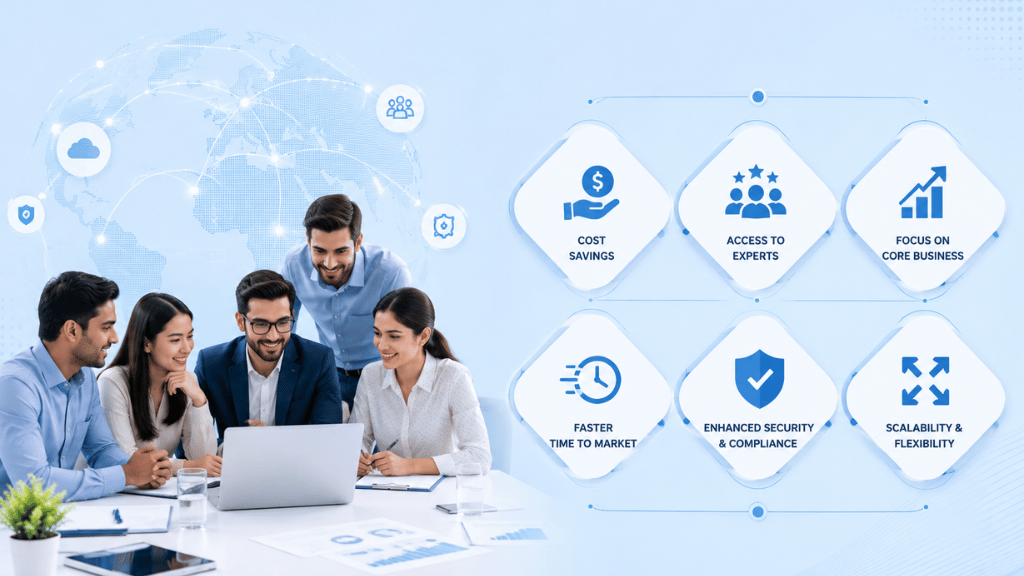
The benefits of IT outsourcing can include access to specialized expertise, greater flexibility, improved support, reduced hiring pressure, and the ability to focus internal resources on core business priorities. However, outsourcing is not automatically the right choice for every organization. Businesses should evaluate costs, security, service quality, contractual responsibilities, and business requirements before selecting a provider.
What Is IT Outsourcing?
IT outsourcing is the practice of using an external company or technology professional to perform specific IT functions instead of handling all those functions internally.
A business might outsource a single service, such as cybersecurity monitoring, or use a managed service provider (MSP) to manage a broader technology environment.
Common outsourced IT services include:
- IT help desk and technical support
- Network monitoring and management
- Cloud infrastructure management
- Cybersecurity services
- Data backup and disaster recovery
- Software development
- Hardware and device management
- IT consulting
- Infrastructure management
- Compliance and security support
- IT strategy and planning
The model can therefore range from partial outsourcing to a largely outsourced IT function. Many businesses also use a hybrid model, keeping strategic or highly specialized functions internally while using external providers for selected services.
Why Do Businesses Outsource IT?
The main reason businesses outsource IT is to obtain capabilities they may not want or be able to build entirely in-house.
For a smaller company, hiring separate specialists for networking, cloud infrastructure, cybersecurity, endpoint management, and technical support may be difficult. An external provider can give the organization access to a broader pool of skills without requiring the company to build every capability internally.
NIST notes that outsourcing cybersecurity can be particularly relevant for small businesses that may not have the expertise, resources, or budget to hire dedicated cybersecurity personnel. It also emphasizes that businesses should define desired outcomes and clearly document service levels, responsibilities, and expectations in formal agreements.
The decision is therefore less about simply “getting rid of IT” and more about finding the most appropriate way to obtain technology capabilities.
10 Benefits of IT Outsourcing
1. Reduce IT Costs
One of the most frequently discussed benefits of IT outsourcing is the potential to control technology costs.
Building an internal IT department can involve salaries, benefits, recruitment, training, software, security tools, infrastructure, and other operating expenses. Outsourcing can convert some of these expenses into a service arrangement with a defined scope and pricing model.
However, outsourcing does not guarantee lower costs. The financial benefit depends on the provider, contract, workload, service requirements, and the cost of maintaining equivalent capabilities internally.
The better question is not simply “Is outsourcing cheaper?” but:
Does outsourcing provide the required IT capabilities at a better overall value than the available internal alternatives?
Businesses should compare total costs rather than comparing a vendor’s monthly fee only with an employee’s salary.
2. Access Specialized IT Expertise
Technology changes quickly, and organizations may need expertise in areas such as cloud computing, cybersecurity, networking, data protection, automation, or specialized business applications.
Hiring a full-time specialist for every technology requirement may not be practical.
An IT outsourcing provider can give businesses access to professionals with different technical skills. This can be especially useful when a company needs specialized assistance for a project or does not have enough internal work to justify a permanent specialist role.
The value is particularly relevant when technology requirements are complex or change frequently.
3. Improve Cybersecurity Capabilities
Cybersecurity is another important reason businesses consider outsourcing IT.
An external security provider or MSP may offer services such as security monitoring, endpoint protection, vulnerability management, incident response support, security assessments, and employee security guidance.
NIST states that businesses can outsource cybersecurity to specialized third parties, including managed service providers, managed security service providers, and fractional security leadership.
However, outsourcing cybersecurity does not transfer all responsibility for protecting business information to the vendor. NIST explicitly cautions that organizations retain responsibility for protecting their business and customers’ information even when cybersecurity functions are outsourced.
Businesses should therefore assess a provider’s security practices, access controls, incident response procedures, data handling, and contractual responsibilities before outsourcing sensitive functions.
4. Scale IT Services More Easily
Business technology requirements can change quickly.
A company might need additional users, devices, cloud resources, applications, or support during a period of expansion. Conversely, it might need fewer resources after restructuring.
Outsourced IT can provide greater flexibility because organizations can negotiate service levels and resource requirements with an external provider instead of managing every change through recruitment or internal restructuring.
This can be particularly useful for growing businesses that do not yet know what their long-term IT staffing requirements will look like.
5. Increase Employee Productivity
Technology problems can interrupt work.
Slow systems, connectivity problems, account issues, application failures, and device problems can consume employee time. A responsive IT support function can help resolve these issues and reduce the burden on employees who are not technology specialists.
Outsourcing can also prevent business leaders from becoming the default technical support team.
Instead of asking managers or employees to troubleshoot recurring technology problems, organizations can establish a defined support process with clear responsibilities.
The result can be a better allocation of employee time toward revenue-generating and operational priorities.
6. Let Employees Focus on Core Business Activities
Another major benefit of IT outsourcing is strategic focus.
Technology is essential, but managing routine IT tasks may not be the best use of a business owner’s or department leader’s time.
Outsourcing appropriate IT responsibilities allows internal teams to concentrate on areas such as:
- Product development
- Customer service
- Sales
- Marketing
- Operations
- Finance
- Business strategy
This does not mean technology becomes unimportant. Instead, the organization can treat IT as a managed business capability while focusing internal attention on activities that differentiate the company.
7. Improve IT Support and Availability
Many businesses need technology support beyond occasional troubleshooting.
A managed IT provider may offer defined support hours, help desk services, monitoring, maintenance, escalation procedures, and service-level commitments.
For organizations without enough internal staff to provide consistent coverage, this can improve the structure of IT support.
The exact level of availability varies by provider and contract, so businesses should not assume that every outsourced IT company offers 24/7 support.
Service availability, response times, escalation procedures, and resolution targets should be explicitly defined in the service agreement.
8. Gain Access to Modern Technology and Tools
Technology providers typically work across multiple environments and clients. Depending on their specialization, they may have experience with cloud platforms, security technologies, monitoring systems, automation, backup solutions, and other modern tools.
Outsourcing can therefore help businesses obtain technology capabilities without building every tool and skill internally.
For example, an organization moving to cloud infrastructure might use an external provider for migration, configuration, monitoring, and ongoing management.
The important consideration is whether the provider’s technology recommendations actually fit the company’s requirements rather than adopting tools simply because they are new.
9. Strengthen Business Continuity
IT outages, hardware failures, cyber incidents, and data loss can disrupt business operations.
An outsourced provider can support continuity through services such as:
- Data backup
- Disaster recovery planning
- System monitoring
- Redundant infrastructure
- Recovery testing
- Incident response
- Business continuity planning
The effectiveness of these services depends heavily on how they are designed and tested.
A business should ask how frequently backups occur, where they are stored, how recovery works, how restoration is tested, and who is responsible during an incident.
10. Make IT Management More Predictable
Outsourcing can also make IT management easier to plan.
A clearly defined managed service agreement may specify the services provided, support levels, responsibilities, response times, pricing, and escalation procedures.
This structure can help business leaders understand what their IT provider is responsible for and where internal responsibilities remain.
NIST recommends clearly understanding and documenting service levels, responsibilities, and expectations when engaging an outside cybersecurity provider.
Predictability, however, comes from good service design and contract management—not simply from outsourcing.
IT Outsourcing vs. In-House IT
There is no universal answer to whether outsourced or in-house IT is better.
Factor | Outsourced IT | In-House IT |
Specialized expertise | Access to external specialists | Requires internal hiring or training |
Staffing | Provider manages much of the staffing | Business manages recruitment |
Scalability | Often easier to adjust services | May require hiring or restructuring |
Control | Shared with provider based on contract | Greater direct control |
Business knowledge | Provider must learn the organization | Internal team has direct context |
Costs | Service-based and contract dependent | Salaries, benefits, tools, and infrastructure |
Support coverage | Depends on agreement | Depends on internal staffing |
Security | Can access specialist support | Organization manages capabilities internally |
Management | Vendor relationship required | Direct employee management required |
Many organizations choose a hybrid IT model instead. They may retain internal employees for business-critical systems and strategy while outsourcing help desk, infrastructure, cybersecurity, cloud management, or specialized projects.
What Are the Potential Risks of IT Outsourcing?
The benefits of IT outsourcing should be balanced against its potential challenges.
Loss of direct control
When an external provider manages systems, the company has less direct control over day-to-day operations. Clear contracts and reporting can reduce ambiguity.
Vendor dependency
A business can become dependent on a provider’s knowledge, systems, or processes. Exit plans and documentation can reduce this risk.
Communication problems
An external provider may not immediately understand internal processes or business priorities. Regular reviews and clear escalation channels are important.
Data and cybersecurity risks
Giving a third party access to systems or information creates additional supply-chain considerations. NIST emphasizes the importance of assessing third-party security and supply-chain risk.
Unexpected costs
A low base price may not include every service a company eventually needs. Businesses should understand included services, additional charges, contract terms, and pricing changes before signing.
Service-quality issues
Not every provider offers the same expertise or support quality. Businesses should assess qualifications, capabilities, experience, reliability, and security practices before selecting a provider.
How to Choose an IT Outsourcing Provider
Businesses should evaluate potential providers systematically rather than choosing solely on price.
1. Define your IT requirements
Document the systems, users, applications, infrastructure, security requirements, and support needs that the provider will manage.
2. Decide what to outsource
You may not need to outsource everything. Determine which responsibilities should remain internal and which can be handled externally.
3. Evaluate technical expertise
Ask about the provider’s experience with your technology stack, industry, business size, and specific requirements.
4. Review security practices
Assess access controls, data protection, monitoring, incident response, employee security, backup procedures, and relevant compliance requirements.
5. Compare service levels
Review support hours, response targets, escalation processes, maintenance procedures, and reporting.
6. Examine the contract carefully
Make sure the agreement explains pricing, services, responsibilities, data ownership, termination terms, access, security requirements, and what happens when the relationship ends.
7. Request references or evidence
Ask prospective providers for relevant experience and evidence that they can meet your requirements.
8. Establish performance metrics
Use measurable KPIs and service-level agreements where appropriate. Regular reviews can help determine whether the provider is delivering the expected value.
FAQs About the Benefits of IT Outsourcing
What are the main benefits of IT outsourcing?
The main benefits can include access to specialized expertise, potentially better cost control, scalability, improved support, cybersecurity capabilities, employee productivity, business continuity support, and greater focus on core business activities.
Is IT outsourcing cheaper than hiring an internal IT team?
It can be, but there is no universal guarantee. The comparison should include salaries, benefits, recruitment, training, software, infrastructure, security tools, management, and other total costs rather than comparing a vendor fee with salary alone.
Why do small businesses outsource IT?
Small businesses often outsource because they may not have the budget or workload required to maintain specialists across every technology area. NIST specifically identifies limited expertise, resources, and budget as reasons small businesses may consider outsourcing cybersecurity.
Does outsourcing IT improve cybersecurity?
It can provide access to specialized cybersecurity skills and services, but outsourcing does not automatically make an organization secure. Businesses remain responsible for managing their risks and should carefully evaluate a provider’s security practices.
Can a business outsource only part of its IT?
Yes. A company can outsource individual functions such as help desk support, cloud management, cybersecurity, backups, or software development while keeping other IT responsibilities in-house.
Is IT outsourcing suitable for startups?
It can be useful for startups that need technology capabilities without immediately building a large internal IT department. The appropriate model depends on the startup’s technology complexity, security requirements, budget, and growth plans.
What is a managed service provider?
A managed service provider, or MSP, is an external company that manages specified IT services for an organization under an ongoing service arrangement. Services can include technical support, infrastructure management, monitoring, cybersecurity, and cloud services.
What should an IT outsourcing contract include?
A contract should clearly define the services provided, responsibilities, service levels, pricing, security requirements, data handling, support procedures, escalation processes, termination terms, and relevant transition or exit arrangements.
Does IT outsourcing mean a company does not need an internal IT employee?
No. Some businesses outsource most IT functions, while others use a hybrid model. Internal technology leadership can remain valuable for strategy, vendor management, business applications, security governance, and aligning technology with business goals.
What is the biggest mistake businesses make when outsourcing IT?
Choosing a provider based primarily on price can be a major mistake. Businesses should also evaluate expertise, security, service levels, reliability, communication, scalability, contract terms, and the provider’s ability to meet specific business requirements.
Conclusion
The benefits of IT outsourcing go beyond reducing the number of IT tasks handled internally. The right outsourcing arrangement can give businesses access to specialized expertise, flexible resources, structured support, cybersecurity capabilities, and technology services that might be difficult to build entirely in-house.
For growing organizations, outsourcing can also allow employees and leadership teams to spend more time on core business priorities rather than routine technology management.
At the same time, outsourcing should not be treated as a guaranteed cost-saving or risk-free solution. Businesses need to assess providers carefully, define responsibilities, protect sensitive information, establish measurable service expectations, and maintain appropriate oversight.
For many organizations, the strongest approach is not choosing between “all outsourced” and “all in-house.” A hybrid IT strategy can combine internal business knowledge with external technical expertise, allowing the organization to build an IT model around its actual needs.